 Chinese
 English
 Russian
 French
Stem Cell Therapy for Diabetic Peripheral Neuropathy: Pilot Data, Schwann Cell Mechanisms, and the Exosome Shift
Up to half of all people with type 2 diabetes eventually develop peripheral neuropathy — burning feet, numbness, night pain that steals sleep. The standard toolkit (gabapentin, pregabalin, duloxetine) takes the edge off the pain signals, but nobody has ever mistaken it for nerve repair. In 2026, the regenerative medicine literature on this problem changed shape: two new systematic reviews have mapped where mesenchymal stem cells (MSCs) and their exosomes actually work in injured peripheral nerves, a mechanistic study nailed down how umbilical cord MSCs resuscitate failing Schwann cell mitochondria, and for the first time a properly powered randomized trial is enrolling.
Why current DPN treatment stops at symptom control
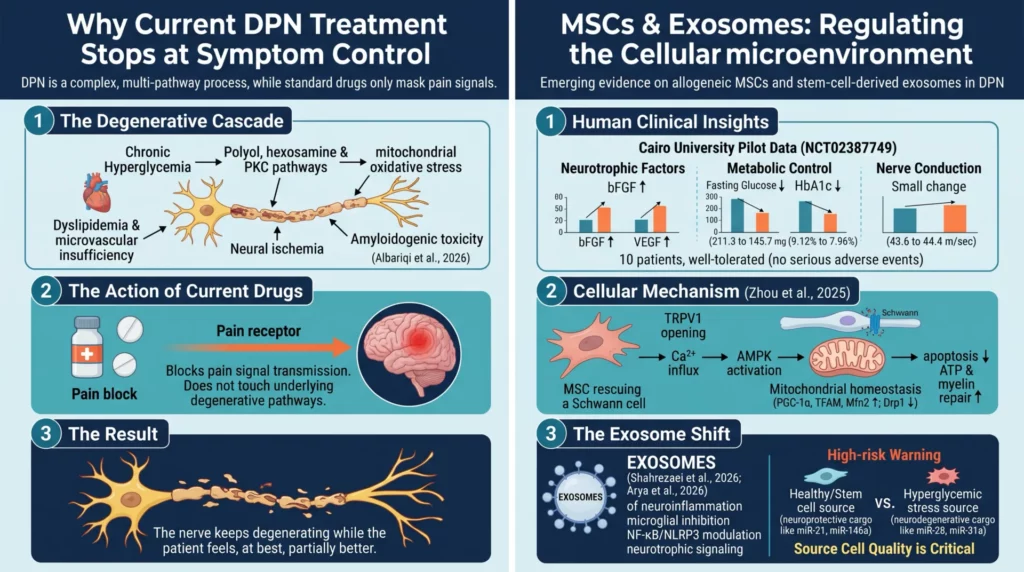
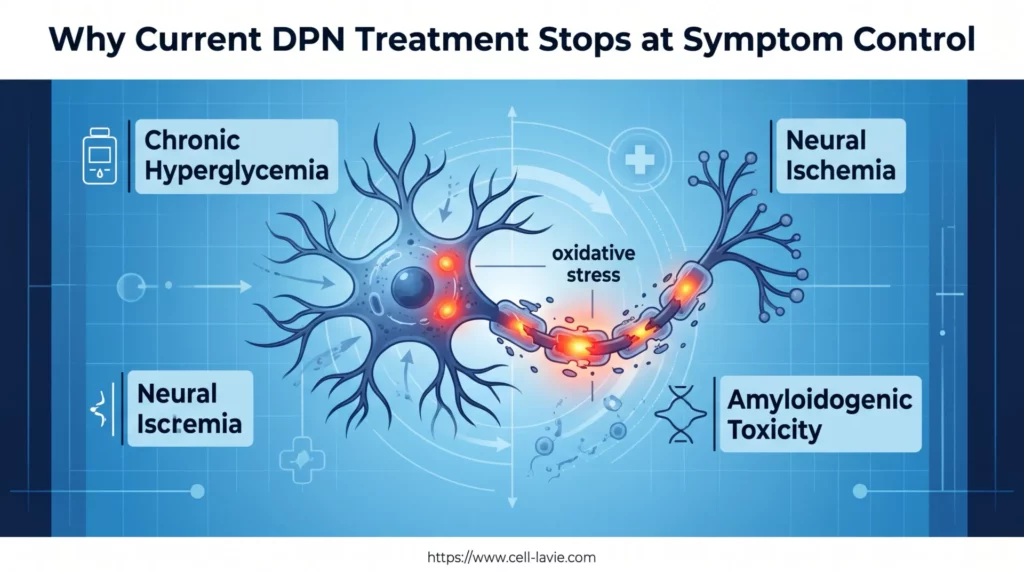
Diabetic peripheral neuropathy (DPN) is not one process. Chronic hyperglycemia activates the polyol, hexosamine, and protein kinase C pathways, raises advanced glycation end-products, and loads the mitochondria of neurons and Schwann cells with oxidative stress. Dyslipidemia and microvascular insufficiency add neural ischemia on top. A 2026 review in Biology by Albariqi and colleagues also points to amyloidogenic toxicity from human islet amyloid polypeptide as a plausible contributor to axonal damage in type 2 diabetes (Albariqi et al., 2026). None of these pathways is touched by a drug that blocks pain signal transmission. The nerve keeps degenerating while the patient feels, at best, partially better.
What the first human studies actually showed
The human evidence base for MSC therapy in DPN is still thin, and it is worth being precise about what exists. The one completed interventional study with posted results is a Cairo University pilot (NCT02387749): ten diabetic patients with peripheral neuropathy received allogeneic MSC transfusion, with measurements at baseline and 90 days (ClinicalTrials.gov, NCT02387749).
- Neurotrophic factors moved: serum bFGF rose from 30.2 to 55.4 and VEGF followed the same direction at day 90.
- Metabolic control improved more than nerve function: fasting glucose fell from 211.3 to 145.7 mg/dL and HbA1c from 9.12% to 7.96%.
- Nerve conduction changed only modestly: mean velocity moved from 43.6 to 44.4 m/sec over the same window.
Ten patients, no sham control, single center. The honest reading: the metabolic signal was real, the electrophysiological signal was small, and the study was never designed to settle efficacy. It does establish that allogeneic MSC administration was tolerable in this population — the trial completed without reported serious adverse events.
Mechanism: how umbilical cord MSCs rescue a starving Schwann cell
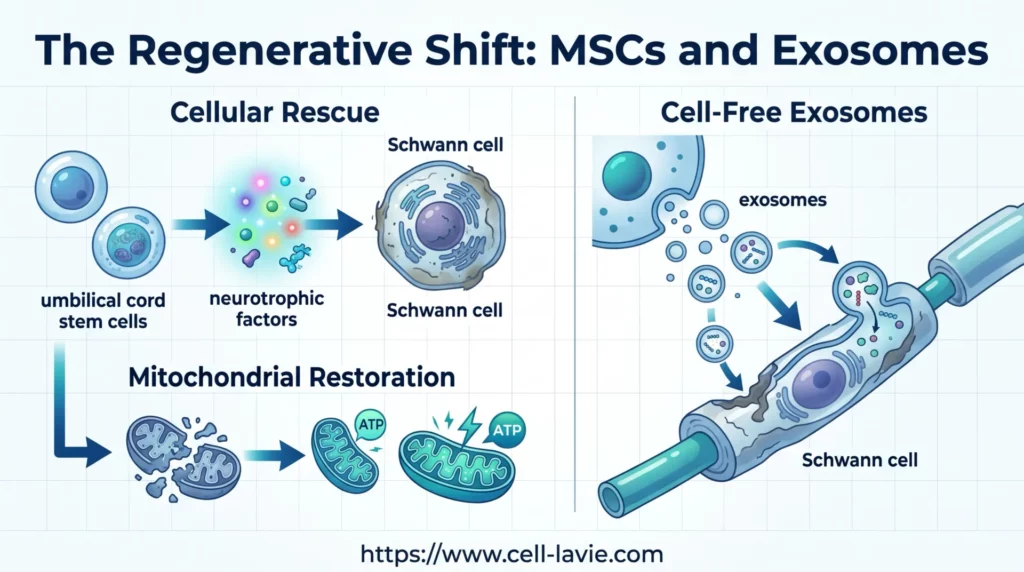
The most complete mechanistic picture this year comes from Zhou and colleagues, published in Stem Cells International (Zhou et al., 2025). In a mouse DPN model, human umbilical cord MSCs (HUCMSCs) reduced mechanical allodynia and thermal hyperalgesia. In cultured Schwann cells exposed to high glucose, the same cells worked through a specific signaling chain:
- Higher p-TRPV1/TRPV1 ratio and intracellular calcium influx — blocked by the TRPV1 antagonist AMG9810, which proves the pathway is required, not just correlated.
- Reduced Schwann cell apoptosis: cleaved caspase-3 and Bax down, Bcl-2 up.
- AMPK activation downstream of calcium — attenuated by both AMG9810 and the AMPK inhibitor compound C.
- Restored mitochondrial homeostasis: PGC-1α, TFAM, and Mfn2 up, fission protein Drp1 down, membrane potential and ATP levels recovered — and these mitochondrial gains disappeared when AMPK was blocked.
The chain, in plain terms: TRPV1 opening lets calcium in, calcium activates AMPK, AMPK switches the Schwann cell’s mitochondria from fission mode back to fusion and biogenesis, and the cell stops apoptosing and starts maintaining myelin again. That matters because Schwann cell failure is the bottleneck in diabetic nerve degeneration — axons cannot be remyelinated if the repair cells themselves are energetically collapsed.
The cell-free shift: exosomes move to the front
Published in October 2026, the first systematic review dedicated to stem cell secretome-derived exosomes for neuropathic pain gives the field its clearest map yet (Shahrezaei et al., Mol Neurobiol, 2026). Following PRISMA 2020 through August 2026, the team found seventeen eligible studies — sixteen preclinical, one pilot clinical. Across chronic constriction injury, diabetic peripheral neuropathy, and chemotherapy-induced neuropathy models, exosome preparations reduced pain-related behavior through four recurring routes: suppression of neuroinflammatory cytokines, inhibition of microglial activation, enhanced neurotrophic signaling, and modulation of the NF-κB and NLRP3 inflammasome pathways. Methodological quality was moderate, and heterogeneity in isolation methods, dosing, and administration routes was severe enough to rule out meta-analysis.
For DPN specifically, Arya and colleagues reviewed adipose stem cell-derived exosomes (ADSC-EXOs) in obesity-driven diabetic neuropathy (Arya et al., Biomed Pharmacother, 2026). Their summary of the preclinical data: ADSC-EXOs improve neuronal insulin response through exosomal miR-155 and PI3K/Akt modulation, damp neuroinflammation via NF-κB/MAPK inhibition and macrophage polarization, restore mitochondrial ATP production in damaged neurons, and push Schwann cells toward neurotrophic factor release. Engineered exosomes loaded with neurotrophin-3 improved axonal regrowth and remyelination beyond unloaded controls in nerve injury models. Because exosomes carry no cellular machinery, they sidestep the immune rejection and tumorigenicity concerns that follow live cell injections.
One finding deserves physician attention. Ghafourian and colleagues, reviewing nine in vivo studies of EV-derived microRNAs in DPN, showed the effect runs both directions depending on the source cell’s health (Ghafourian et al., J Mol Neurosci, 2026). Vesicles from healthy or stem cell sources carry neuroprotective cargo — miR-21, miR-146a, let-7a, miR-20b-3p — that improves myelin integrity, nerve conduction, and neurovascularization. But vesicles harvested from cells under hyperglycemic stress were enriched in neurodegenerative miRNAs (miR-28, miR-31a, miR-221) that made neuropathy worse. Source cell quality is not a marketing detail; it determines whether the product helps or harms. That is a strong argument for characterized, GMP-produced vesicle preparations over unstandardized commercial “exosome” products.
Trials enrolling right now
| Trial | Design | Primary endpoint | Status |
|---|---|---|---|
| NCT07183761 | Phase 2, N=140 (estimated), intramuscular umbilical cord MSCs vs control, Southwest Hospital China, started Oct 2025 | Toronto Clinical Scoring System at week 24; safety followed to week 104 | Recruiting |
| NCT05152368 | Phase 1, N=20, allogeneic umbilical cord/placental MSC exosomes for trigeminal neuralgia | Safety and tolerability | Recruiting |
| NCT02387749 | Open-label pilot, N=10, allogeneic MSC transfusion, Cairo University | Nerve conduction and neurotrophic factors at 90 days | Completed, results posted |
NCT07183761 is the one to watch. Its design solves the field’s recurring problems: sham-controlled comparison, a clinical score rather than symptom self-report alone, electrophysiological and quantitative sensory testing as secondary endpoints, and two years of safety follow-up. First week-24 readouts should land in 2027.
Safety and where this stands regulatorily
Across the published DPN work, MSC and exosome administrations have produced no serious adverse events, and the Cairo pilot and the trigeminal neuralgia trial both report tolerable safety profiles. That said, the human evidence base totals a few dozen patients. Route of administration shapes the risk profile — intrathecal MSC delivery in multiple sclerosis trials produced inflammatory signals that did not appear with intravenous or intramuscular dosing — and any clinician evaluating a DPN candidate should ask which route was used and why.
常问问题
Is stem cell therapy approved for diabetic neuropathy?
No. As of late 2026, no regulatory agency — not the Thai FDA, not the US FDA, not the EMA — has approved MSC or exosome therapy for diabetic peripheral neuropathy. The evidence is at the Phase 2 stage. Clinics offering it commercially are operating outside approved indications, and patients should weigh that accordingly.
What is the difference between stem cell therapy and exosome therapy here?
Stem cell therapy injects living MSCs that engraft temporarily and secrete repair factors. Exosome therapy delivers only the vesicles those cells produce — cell-free, no engraftment, no risk of uncontrolled cell growth, easier to standardize. Both are still experimental for DPN. The exosome approach is arguably moving faster in the pain literature, but product characterization remains the field’s weakest link.
How is the therapy administered?
The active Phase 2 trial uses intramuscular injection near affected limbs. Other protocols use intravenous infusion, and intrathecal delivery has been tested in neuropathic pain models. Route matters for both safety and whether the vesicles or cells reach the damaged nerve in meaningful concentration.
When could this become mainstream treatment?
Realistically, after NCT07183761 reports (expected 2027) and a subsequent confirmatory trial. Even a clean Phase 2 result would put regulatory approval several years out. Anyone telling patients this is ready for prime time is ahead of the data.
What should a diabetic neuropathy patient do now?
Optimize glycemic control, blood pressure, and lipids — those remain the only interventions with proven effect on DPN progression. For pain, work with a neurologist on the existing pharmacological options. If a clinical trial slot exists and the diagnosis is confirmed with nerve conduction studies, enrollment in a trial like NCT07183761 is a reasonable way to access the therapy under proper oversight.
参考
1. Shahrezaei A, Dashti L, Nasirinezhad F. A Systematic Review of Stem Cell Secretome-Derived Exosomes for Neuropathic Pain: Therapeutic Mechanisms and Translational Potential. Molecular Neurobiology. 2026;63(1):950. doi:10.1007/s12035-026-06225-9
2. Arya DK, Perie L, Mohanta GC, et al. Adipose stem cell-derived exosomes as emerging neurotherapeutics in obesity induced diabetic neuropathy. Biomedicine & Pharmacotherapy. 2026;198:119218. doi:10.1016/j.biopha.2026.119218
3. Zhou YK, He JD, Yang XC, et al. Human Umbilical Cord Mesenchymal Stem Cells Ameliorate Diabetic Neuropathic Pain via TRPV1-[Ca²⁺]i-AMPK Signaling-Mediated Mitochondrial Restoration in Schwann Cells. Stem Cells International. 2025;2025:5533136. doi:10.1155/sci/5533136
4. Ghafourian AR, Mohseni AS, Ghasemi R, et al. Preclinical Evidence of Extracellular Vesicle-derived MicroRNAs in Relieving Diabetic Peripheral Neuropathy: A Systematic Review. Journal of Molecular Neuroscience. 2026;76(2):78. doi:10.1007/s12031-026-02500-5
5. Albariqi MMH, Alradwan IA, Alqahtani SM, et al. Diabetic Peripheral Neuropathy: Mechanisms and Emerging Therapies. Biology. 2026;15(9):723. doi:10.3390/biology15090723
6. ClinicalTrials.gov: NCT07183761 (Phase 2 intramuscular UC-MSC for moderate-to-severe DPN); NCT05152368 (Phase 1 MSC exosomes for trigeminal neuralgia); NCT02387749 (MSC transfusion pilot in diabetic peripheral neuropathy).