
 French
 English
 Chinese
 Russian
Thailand Medical Visa Guide for Stem Cell Treatment (2026)
The passport slides across the desk at Suvarnabhumi and the officer asks the question that decides your fortnight: “How long?”
A patient of mine answered that question badly. He said two weeks. He stayed five. Not out of defiance — his knee swelled on day nine, the review got pushed, the flight got moved, and nobody in the chain noticed that the stamp in his passport had quietly become the most expensive document in the trip. He paid a fine at the airport, missed the rebooked flight anyway, and spent the next year explaining an overstay stamp at visa counters from Doha to Frankfurt.
Patients get this wrong more often than they get the treatment wrong, and the consequences are worse. A missed extension is a fine, an overstay stamp, and sometimes a conversation you’d rather not have with an airline.
First, the thing that is not a visa
Being treated at a Thai clinic is not, by itself, a visa category. You enter on whatever status you qualify for, and you are treated as a visitor who happens to be receiving care.
That sounds pedantic until you’re the person whose tourist entry expires on day 60 with a second injection scheduled on day 66. Immigration counts days, not protocols.
What each route actually gives you
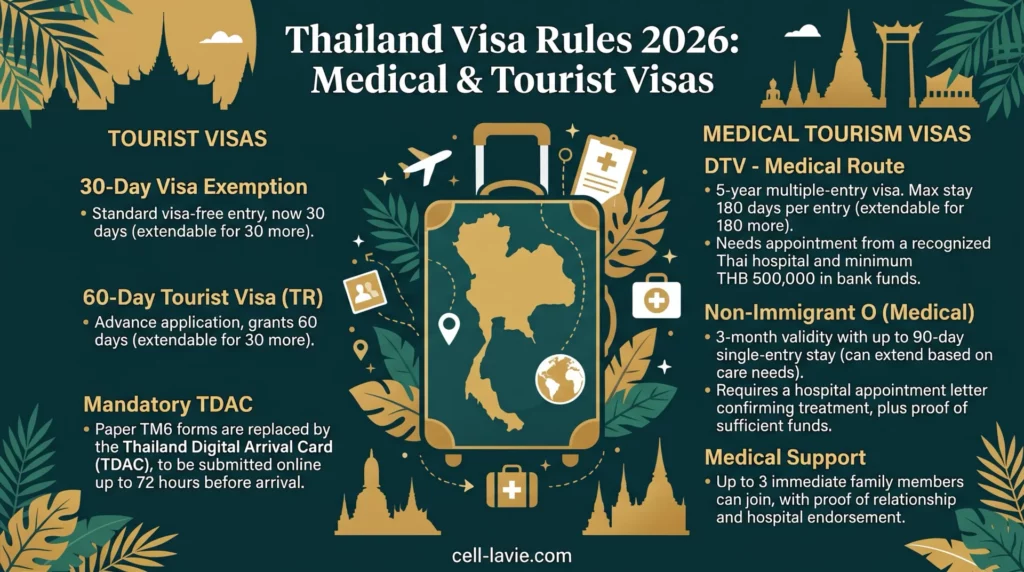
Most nationalities arrive visa-exempt or on a tourist visa with 30 or 60 days, depending on passport and how they entered. Sixty is the common case for the nationalities we see most — American, British, Australian, EU — though it changes, and the list is not the same two years running. Do not plan a protocol on the number you remember from a 2023 blog post.
The Destination Thailand Visa, introduced in 2024, changed the arithmetic for long-stay visitors: five-year validity, 180 days per entry, extendable once by another 180, with a financial proof requirement in the region of half a million baht. For a patient on a staged protocol, or a couple doing it together, that’s frequently the better instrument than a tourist entry plus two extensions. It is also paperwork, and paperwork takes longer than the flight booking.
The Long-Term Resident visa is a different animal again — higher income thresholds, targeted at remote workers and wealthy retirees, not at medical travellers. If someone tries to sell you an LTR for a knee injection, be sceptical of everything else they’ve told you.
The extension, which is where people panic
Thai immigration does grant extensions for medical treatment, and clinics issue the letters that support them — appointment confirmation, treatment plan, the physician’s summary, hospital or clinic licence details. In practice a medical extension is usually granted in 90-day increments at the discretion of the officer, and “discretion” is the operative word.
What makes the difference is preparation and timing. Go to the immigration office with more days left than you think you need, not fewer. Bring the letter, the passport, photographs, the fee in cash, and copies of everything — the copy shop outside is a business for a reason. If you are on a 30-day exemption, start the process in week two, not day 27.
And do not, under any circumstances, work remotely for your employer on a tourist entry. That is a separate offence with a separate penalty, and “I was only answering emails” is not the defence people think it is.
Re-entry, and the trip home in the middle
Some protocols run over months with gaps. Every exit and entry consumes or resets your permission depending on the visa type, and a multi-entry tourist visa behaves nothing like a single-entry one.
If your plan involves flying home between sessions — which is common for the staged orthopaedic protocols — tell the clinic before anything is booked, and ask which entry status they’d recommend for the second visit. We’ve had patients leave on a single-entry visa, come back, and discover the second entry had different conditions from the first.
What the clinic actually needs from you
For the support letter, we need your passport details, the dates you intend to be here, and a treatment plan specific enough to describe the number of sessions. What we cannot do is invent a plan to buy you time. A letter that doesn’t match the medical record is a letter that will not survive scrutiny, and we’ve declined to write those.
Also worth saying plainly: nobody in this building can influence an immigration decision, and anyone who tells you they can should be reported rather than paid.
We stay with you for as long as the treatment runs
Whatever the protocol needs, the paperwork has to keep pace with it. A single injection is a long weekend. A staged orthopaedic course can run a month. Some protocols run across a year with reviews in between, and each return is its own immigration event.
Our coordination covers the whole span, not just the first arrival. We prepare the appointment letters and treatment plans that immigration asks to see, we tell you when to start an extension rather than when it’s nearly too late, and we keep the documentation current if your review dates move. If a protocol slips by a week because your knee swelled, the letter slips with it — that is a clinic process, not something you should be chasing from a hotel room.
The same applies to re-entry. If you’re going home between sessions, we’ll tell you which entry status to travel on for the second visit and what to have in your hand at the desk, so that the trip home doesn’t create a problem on the way back.
What we can’t do is influence a decision. Nobody at this clinic can, and anyone who tells you otherwise should be reported rather than paid. What we can do is make sure that when an officer looks at your file, everything they need is already in it — and that you’re never the patient standing at a counter explaining a date the clinic got wrong.
How long the treatment itself takes
For most joint injections, two to four days on the ground is realistic, with the rest of the stay being your own recovery week in Bangkok rather than appointments. Intravenous protocols vary more — some are a single infusion, others run over several days, and a few run across weeks with reviews in between.
The practical advice is to build in a buffer on the exit end. Not because the treatment needs it, but because a flight the morning after an infusion, with a mild temperature and a swollen knee, is a worse experience than a flight two days later, and rebooking is more expensive than a hotel night — and both are small next to the overall cost of treatment in Thailand.
If you’re planning dates and want the stay length mapped against your protocol rather than a generic answer, the team can do that properly through the contact form on the home page. Bring your travel window and they’ll tell you where it fits and where it doesn’t.
Two habits that prevent most of the trouble
Photograph every stamp and every visa sticker, and keep the photographs where you can reach them without a data connection. Immigration officers ask for history, and a passport in a hotel safe is not an answer.
And check the current rules close to your travel date, not six months out. The DTV is new, the exemption lists move, and the fee schedule changes without announcement. Any guide, this one included, is a starting point rather than a legal opinion.
Laisser un commentaire
Vous devez vous connecter pour publier un commentaire.