
 Russian
 English
 Chinese
 French
Mesenchymal Stem Cell Therapy in Cervical Cancer: What the 2026 Evidence Shows
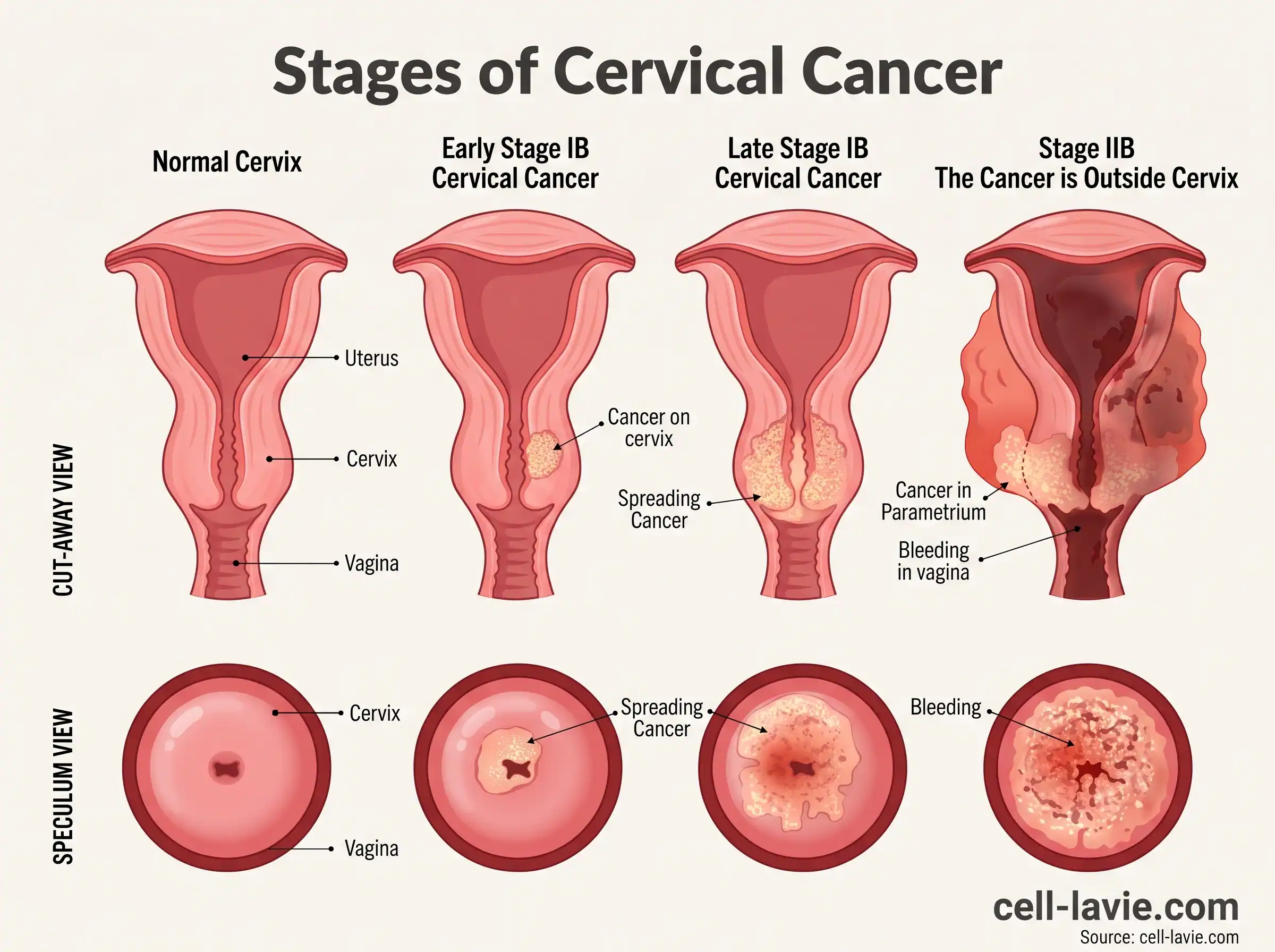
Cervical cancer remains one of the heaviest oncology burdens in Southeast Asia. More than 660,000 women are diagnosed with it each year, roughly 350,000 die, and almost every case traces back to persistent infection with high-risk human papillomavirus, mainly HPV16 and HPV18. Surgery, chemoradiation and checkpoint blockade have all moved outcomes forward for early and recurrent disease, yet tumors that come back after first-line treatment still carry poor odds. That gap is why mesenchymal stem cells (MSCs) keep showing up in the cervical cancer literature. They migrate toward tumor stroma, they reprogram immune responses, and they can be loaded with drugs or engineered before infusion.
They also sit in an awkward position. The same immune-dampening behavior that makes MSCs useful in graft-versus-host disease and autoimmune conditions can shield a growing tumor from immune attack. Two reviews published this year confront that contradiction head-on. The larger one, a PRISMA systematic review in Critical Reviews in Oncology/Hematology by Iqbal and Abuwatfa, screens eight databases, includes 14 studies, and shows that the field has produced opposite conclusions while never measuring the one variable that defines this disease: HPV oncogenic activity.
Why MSCs end up inside cervical tumors
Tumor cells do not sit still while tissue repairs itself around them. Cervical cancer models show MSCs drawn in along chemokine gradients, retained in the stroma, and then educated by cancer cells, macrophages and cancer-associated fibroblasts that they contact. The result is a cell whose behavior no longer matches the donor tissue it came from. Bautista-Sebastián and colleagues isolated MSCs from cervical tumors and compared them with MSCs derived from normal cervix, and the two populations instructed macrophages in opposite directions. An MSC product infused into a patient therefore arrives at a site that can rewrite what those cells do.
The 2026 systematic review: 14 studies, one blind spot
Iqbal and Abuwatfa followed PRISMA 2020 guidelines across eight databases and kept studies that reported an MSC intervention for cervical cancer with at least one immune-related outcome. Fourteen studies met the bar: 13 completed preclinical experiments and one ongoing clinical trial. Half the evidence pointed toward immune evasion, driven through adenosine, IL-10 and M2 macrophage polarization. The other half pointed toward tumor suppression, working through STAT3, Wnt/β-catenin and epigenetic pathways.
The blind spot is what those studies left out. Of the 13 completed investigations, none measured HPV oncogenic activity as an experimental variable, and only two included an HPV-negative cohort. Differential effects of MSC exosomes on HPV16 and HPV18 cell lines were observed but never linked to genotype. The authors argue this matters because E6 and E7 oncoprotein signalling feeds into PD-L1, TGF-β, STAT-3 and NF-ΩB, which are the same nodes MSCs act on. Their recommendation is blunt: stratification by HPV oncogenic status should be a methodological requirement before any of this evidence can be interpreted or translated.
One set of pathways, two opposite outcomes
Li and Wang’s review in Oncology Letters walks through both arms of the mechanism, and Poorhoseini and colleagues frame the same problem for HPV-infected tissue specifically. The pattern breaks down like this:
- The tumor-shielding arm: MSCs and their exosomes raise adenosine and IL-10, push macrophages toward an M2 phenotype, expand regulatory T cells, and switch on anti-inflammatory signalling that blunts the local immune response.
- The tumor-fighting arm: in other models the same cells suppress STAT3 and Wnt/β-catenin signalling, shift epigenetic regulation, promote apoptosis and slow angiogenesis, which shrinks tumor burden.
- The HPV-specific trap: MSC exosomes suppress NF-ΩB and calm chronic inflammation in infected cervix, but that same calming effect may impair local immune surveillance and give persistent virus more time to establish itself.
Which arm wins depends on the local context, and right now the literature does not let readers predict it. That is the honest summary of where the field stands.
Thai spheroid data: HeLa responds, SiHa pushes back
The most informative recent experiments come from Prince of Songkla University in Hat Yai, where groups led by Navakanitworakul have modeled cervical tumors in three dimensions. Molika and colleagues pretreated HeLa and SiHa spheroids with MSC-derived exosomes before chemotherapy. Proteomics on the exosomes flagged ANXA1, ANXA2, EEF2, LGALS1 and PKM2 as cargo linked to tumor regeneration and drug response.
- HeLa spheroids: MSC-exosome pretreatment deepened paclitaxel response with cisplatin or carboplatin, with lower viability, higher caspase activity and raised Bax.
- SiHa spheroids: paclitaxel-cisplatin gained nothing, while paclitaxel-carboplatin improved, most visibly inside the spheroid core.
- Chemoradiotherapy study: Nittayaboon and colleagues paired bone marrow MSC exosomes with chemoradiotherapy and found HeLa spheroids shrinking through NF-ΩB1 (P50)-driven apoptosis, while SiHa lost viability without caspase activation as HSP27 rose and apoptotic molecules fell.
HeLa carries HPV18 and SiHa carries HPV16, so the divergence between the two lines tracks along genotype lines. The teams did not frame their results that way, and the lines differ in more than HPV type alone, so this is a signal rather than proof. It is still exactly the kind of stratification the systematic review says the field is missing.
Tumor-educated MSCs reprogram macrophages
Bautista-Sebastián and colleagues ran cocultures of cervical cancer tumor cells with macrophages, adding either normal cervix MSCs or tumor-derived MSCs. Macrophages sitting with tumor-derived MSCs raised intracellular IDO, IL-4 and IL-10, released more soluble IL-10, and suppressed T lymphocyte proliferation more effectively. They also acquired a stronger M2 profile and a greater capacity to generate regulatory T cells. The conclusion was direct: communication between MSCs and tumor cells in cervical cancer can promote tumor growth by producing macrophages with heightened immunosuppressive activity.
Conditioned medium and cancer cell metabolism
A newer in vitro study from Roozbehani and colleagues asked what adipose-derived MSC conditioned medium does to HeLa cells. Viability fell with a half-maximal inhibitory concentration at 38.99% conditioned medium, and the 20% condition raised the apoptotic cell fraction. SIRT2 expression dropped (p = 0.0036) and SIRT7 rose (p = 0.0036), while SIRT1 and NAMPT did not shift. The authors are careful about the limits: active components were not identified, and protein-level and enzyme-activity confirmation is still needed before any causal claim.
What is actually running in patients
Very little, and that is the point. The systematic review found a single ongoing clinical trial among its 14 included studies. A direct search of ClinicalTrials.gov for mesenchymal stem cell trials in cervical cancer, run through the registry’s v2 API on 6 November 2026, returned no interventional MSC study in this disease; the closest matches were trials in radiation-induced dry mouth and head and neck cancer. On the regulatory side, no agency has approved MSC therapy for cervical cancer: not the US FDA, not the EMA, not the Thai FDA. Any clinic offering it for this diagnosis is working entirely outside an evidence base.
Preclinical strategy work keeps moving anyway. Nedunchezhian and colleagues map where the field is heading: MSCs as carriers for chemotherapeutic agents, targeted drug delivery systems, genetically modified cell therapies, and exosome-based approaches aimed at EMT, NF-ΩB, miR-144-3p, CEP55 and CD73 signalling. Those are laboratory programs with real rationale behind them, not treatments available to patients in 2026.
Where this leaves patients at our clinic
At our clinic, the conversation about cervical cancer starts with screening, HPV vaccination where it applies, and the standard oncology pathway, because those interventions have survival data behind them. We do not offer MSC therapy for cervical cancer, and we would not steer a patient toward it outside a properly registered trial. What we do watch with interest is the stratification work: if HPV genotype turns out to predict which tumors MSCs suppress and which they help, the same cells could end up with a defined, defensible role in oncology. We are years from that, and patients should be wary of anyone selling the destination today.
Frequently asked questions
Is mesenchymal stem cell therapy approved for cervical cancer?
No. As of November 2026, no regulatory agency, including the US FDA, the EMA or the Thai FDA, has approved MSC therapy for cervical cancer. The published evidence is preclinical, apart from one ongoing trial identified in the 2026 systematic review.
Can stem cells make cervical cancer worse?
It is possible in experimental models. MSCs can raise IL-10 and adenosine, polarize macrophages toward an M2 phenotype, and reduce T cell proliferation, all of which help tumors evade immunity. Whether that happens in a given patient is unknown, which is why the reviewed studies are considered contradictory.
What are MSC exosomes doing in cervical cancer research?
They are being tested as a cell-free alternative that can be dosed and standardized more easily than living cells. Thai work in 3D spheroids shows they change chemotherapy response in ways that differ between HPV18 HeLa and HPV16 SiHa models. Everything published so far is laboratory research.
Why does HPV genotype keep coming up?
Because E6 and E7 oncoprotein signalling feeds PD-L1, TGF-β, STAT-3 and NF-ΩB, and those are the same pathways MSCs act on. A review of 14 studies found none that controlled for HPV oncogenic activity, so the field cannot yet say which patients would benefit and which could be harmed.
Can I join a clinical trial for stem cell therapy in cervical cancer?
A ClinicalTrials.gov search on 6 November 2026 found no registered interventional MSC trial for this cancer. Check trial registries regularly and talk to your oncologist before changing any part of your treatment plan.
использованная литература
Iqbal H, Abuwatfa WH. Immunological consequences of mesenchymal stem cell therapy in HPV-driven cervical cancer: A systematic review and stratification framework. Critical Reviews in Oncology/Hematology. 2026 Nov;227:105570. doi:10.1016/j.critrevonc.2026.105570
Li X, Wang D. Role of mesenchymal stem cells and their derived exosomes in cervical cancer: Bidirectional mechanisms and research progress (Review). Oncology Letters. 2026;31(6):225. doi:10.3892/ol.2026.15580
Poorhoseini Hanzaii F, Soleimani M, SoufiZomorrod M. Mesenchymal stem cell-derived exosomes as a double-edged sword: Balancing inflammation and immunosuppression in human papillomavirus-infected tissues. Stem Cells International. 2026;2026:2596453. doi:10.1155/sci/2596453
Molika P, Nittayaboon K, Kerdkumthong K, Navakanitworakul R. Mesenchymal stem cell-derived exosomes reprogram chemosensitivity pathways in cervical cancer spheroids. International Journal of Molecular Sciences. 2026;27(3):1575. doi:10.3390/ijms27031575
Nittayaboon K, Molika P, Bissanum R, et al. Bone marrow mesenchymal stem cell-derived exosomes modulate chemoradiotherapy response in cervical cancer spheroids. Pharmaceuticals (Basel). 2025;18(7):1050. doi:10.3390/ph18071050
Bautista-Sebastián E, Cortés-Morales VA, Fajardo-Orduña GR, et al. Interaction between mesenchymal stromal cells and tumor cells present in cervical cancer influences macrophage polarization. Cancers (Basel). 2025;17(19):3099. doi:10.3390/cancers17193099
Roozbehani M, Vafaei S, Keyvani H, et al. Modulation of the NAMPT/SIRT axis in HeLa cells exposed to adipose-derived mesenchymal stem cell-conditioned medium. Molecular Biology Reports. 2026;53(1):1780. doi:10.1007/s11033-026-12873-w
Nedunchezhian S, Palaniyandi T, Surendran H, et al. Strategies for cervical cancer treatment using the regenerative potentials of mesenchymal stem cells. Current Pharmaceutical Design. 2026 (online ahead of print). doi:10.2174/0113816128501994260915105716